

I really enjoy that moment when a student brings in a new guitar. I see them smiling as they enter the room. This is especially true if it’s their first guitar ever. They’re so excited no matter what kind of guitar they’re holding. In that moment, they’re a rock star.
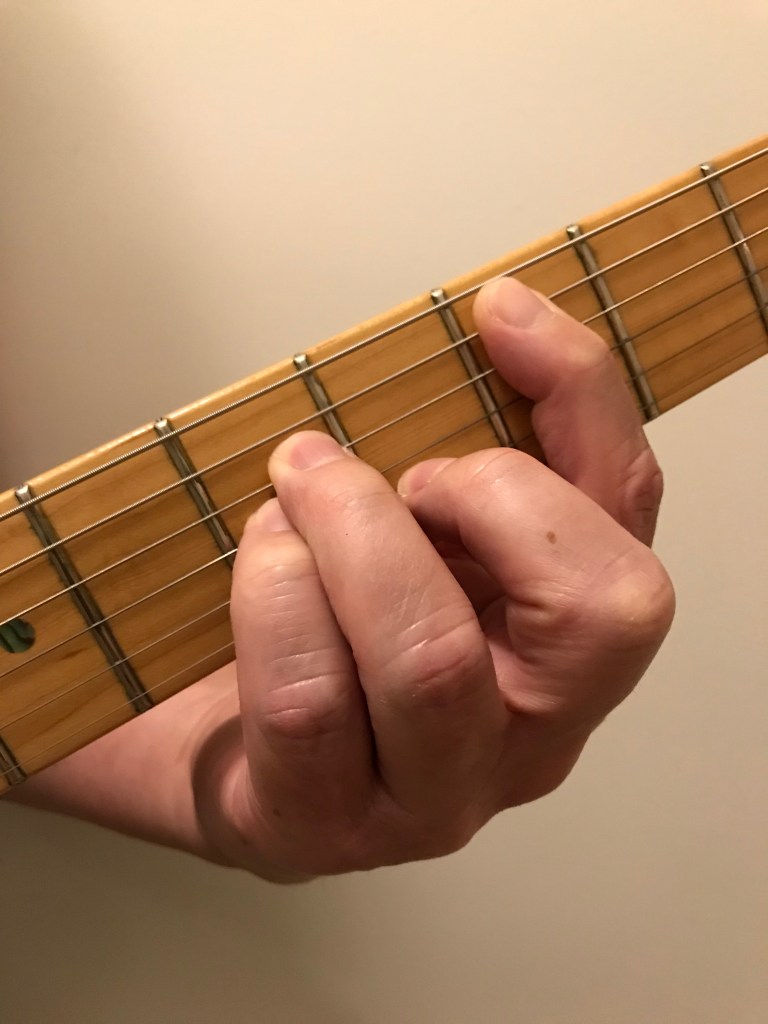
Guitar strings are always important, but when you’re first beginning to play, strings can hurt your fingers. They might be hard to press, so it can be painful until your fingers get used to holding the strings down on the frets.
Even when you’ve been playing for many, many years, strings are important. Let’s say you buy a new guitar, and even though you like your new guitar, it might feel harder to play. If that’s the case, check your strings.
Strings make a huge difference.
First, how high the strings are – or what we call “action” – is very important. Action is basically the height of the strings over the frets.
Having higher action means the strings are harder to press. Having lower action means the strings are easier to press. Even though lower action is easier, there’s a trade-off in how the guitar sounds that you need to think about. Keep this in mind:
*Buzzy sounds or buzzy strings come from action that is too low
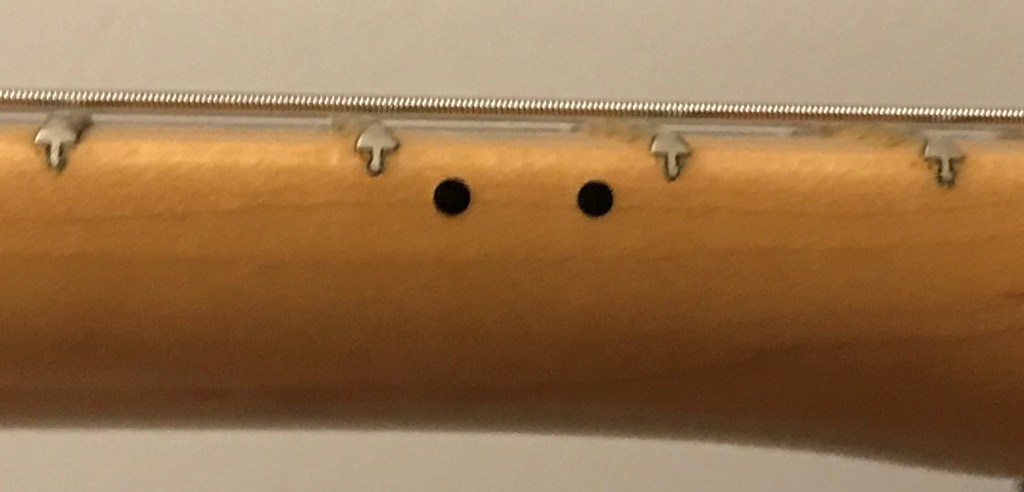
*Difficulty in pressing the strings down comes from action that is too high
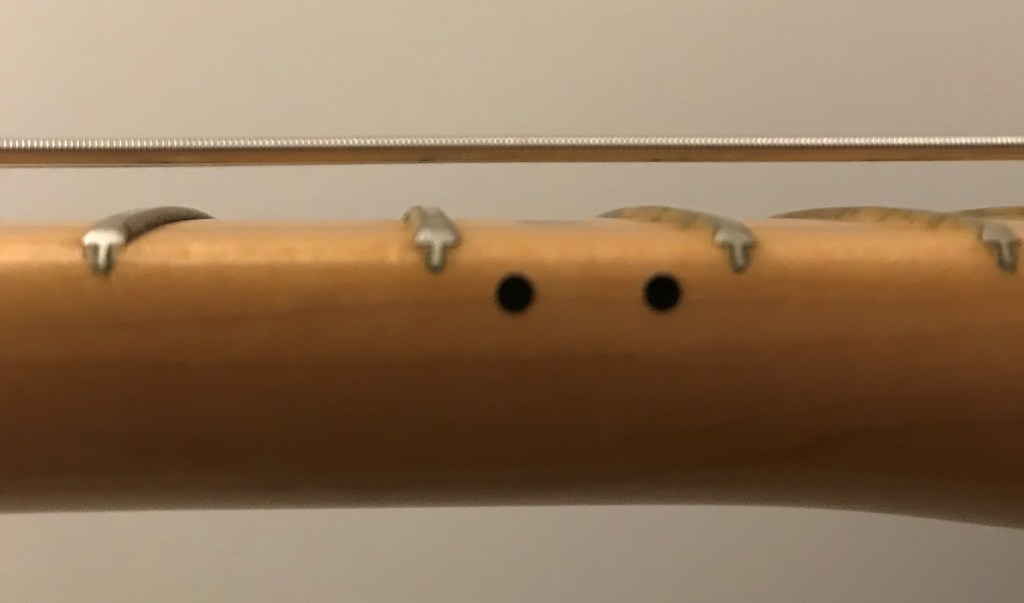
These issues are pretty easy to address by adjusting action on the guitar. I’ll describe that in another post. But for now, let’s talk about the strings themselves.
There’s 2 basic things you need to know about guitar strings:
- The quality of the strings matter. New guitars will almost always have poor quality strings on them, especially if they come directly from a manufacturer. To keep costs down, manufacturers don’t often use expensive strings. They use bulk strings. Of course, there are exceptions among some manufacturers. If you buy a Fender custom shop guitar, you’ll probably receive the guitar with decent strings, and it’ll be set up to play well when you first pick it up. That said, I have seen a high-end Fender Stratocaster, come in needing a complete setup, and I’ve seen a much less expensive Squier Stratocaster, come in needing no work at all because it played well from day one. When you buy a used guitar, it’s likely that they’ll have old strings that need replacing, even if only to get to the brand and tension that you prefer. The point is, the quality of the strings makes a huge difference in how a guitar feels and sounds.
- The lighter the tension of the string, the easier they are to press down. There are running debates, with some people arguing that lighter string tension has less tone and other people arguing the opposite. The fact that there are arguments about this tells you that this may be a matter of opinion. My advice: play the guitar and decide how it feels. If you don’t like it, think about how your fingers feel on the strings and figure out if it’s worth changing them. Experiment a little. Over time, you come to know what works best for you.
I have electric guitars in my collection that use string gauges from .009 (light tension) to .011 (heavier tension).
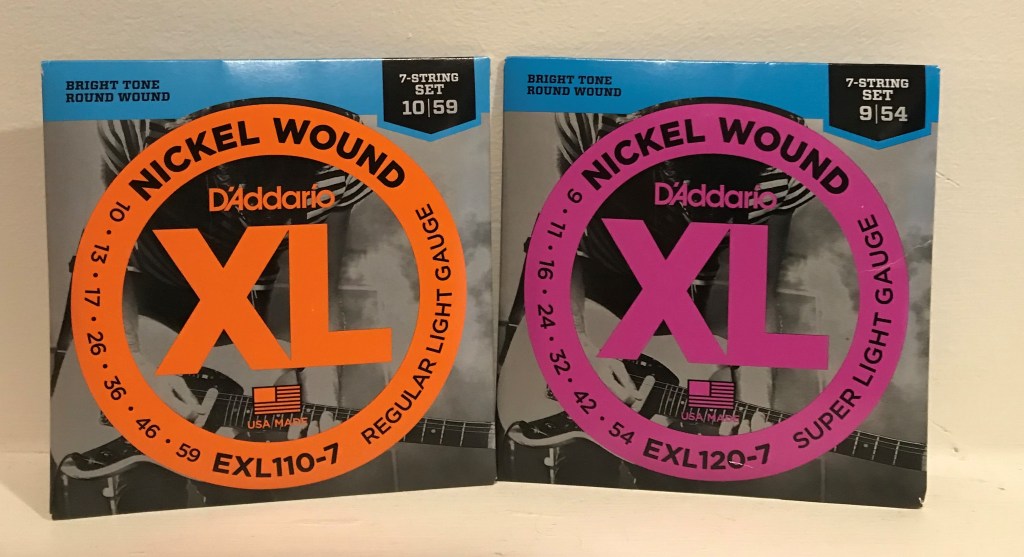
Those are the highest and lowest that I’m comfortable with, but manufacturers make string sets that are lighter and heavier than these.
You may be wondering what these numbers actually mean. The numbers for string tension refer to the diameter of the highest pitched string on the guitar, the high E string or string number one. The high E string is shown in the picture below.
The numbers represent thousandths of an inch, but we don’t refer to them as “twelve one thousandths of an inch” in the guitar world. We would just say “a set of twelves” (or “a set of nines” if you’re referencing nine one thousandths of an inch or .009, for example).
- When the diameter of the string goes up, that means the tension also goes up.
- When the diameter of the string goes down, the tension goes down.
The higher tension (larger diameter) strings are harder to press. Lower tension strings are easier to press. But it’s not just a matter of going to a lighter gauge to make your guitar play easier.
I have guitars that feel better with different string tensions because of the tuning I use or the scale length, which is the distance between the bridge and the nut, or the playable length of the string.
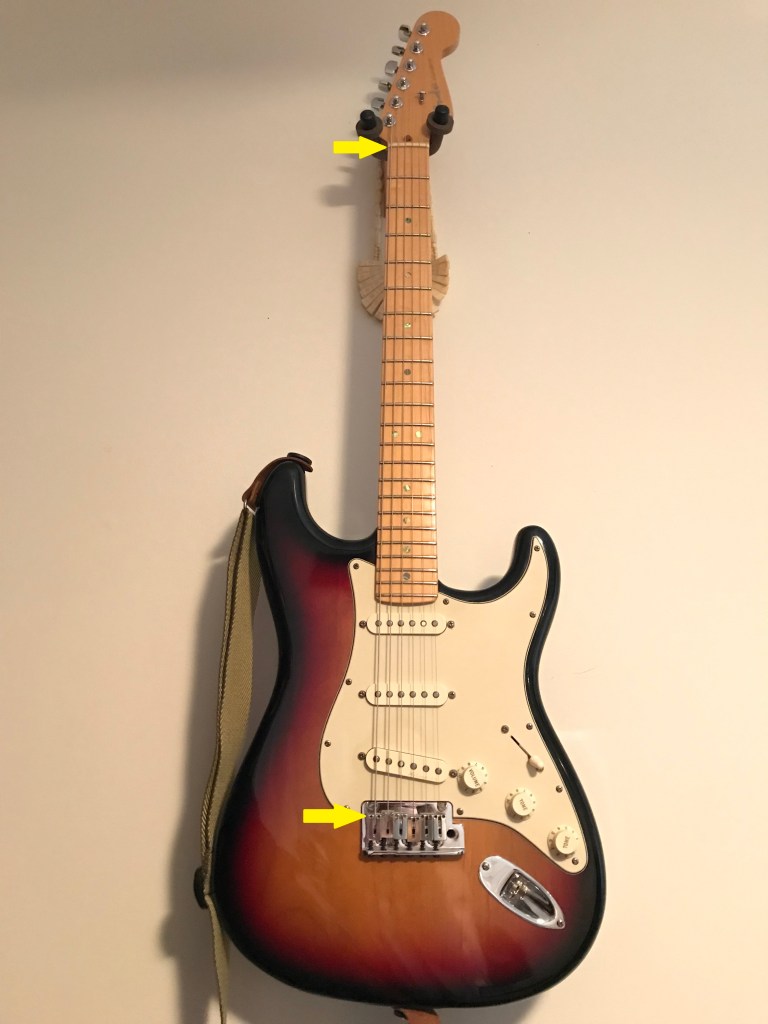
Regarding the tuning I use…One of my bands tunes to E standard, while another group uses D standard. I’ll address tunings in another post, but for now just know that the lower you tune a string, the less tension it has.
It should make sense that as you lower tension by tuning lower, you can raise tension by using heavier string gauges. In other words, two guitars using completely different string gauges and also in two different tunings can basically feel the same to a player.
Think that through…Do you see why it makes sense that your string tension depends on your tuning? If not, message me to request a post explaining this.
So, summing up.
- -When you buy a guitar – whether new or used – I suggest you change the strings.
- -If you know what you brand and tension you like, that’s great but remember that the strings may still require adjustment. We call that “setting up” a guitar.
- -If you don’t know what brand and tension you like, it’ll take some time to experiment, but know this:
- The standard string gauge for standard tuning will usually use either a set of 9s or a set of 10s (.009 gauge or .010 gauge for the high E string). But strings are relatively inexpensive, so it’s worth buying a set of each gauge to find out which you like best.
You may have noticed from the links above that I prefer D’Addario strings for most of my instruments. I also use these exclusively for my electric guitars.
I’ve also used Ernie Ball strings, SIT strings, and Elixir strings.
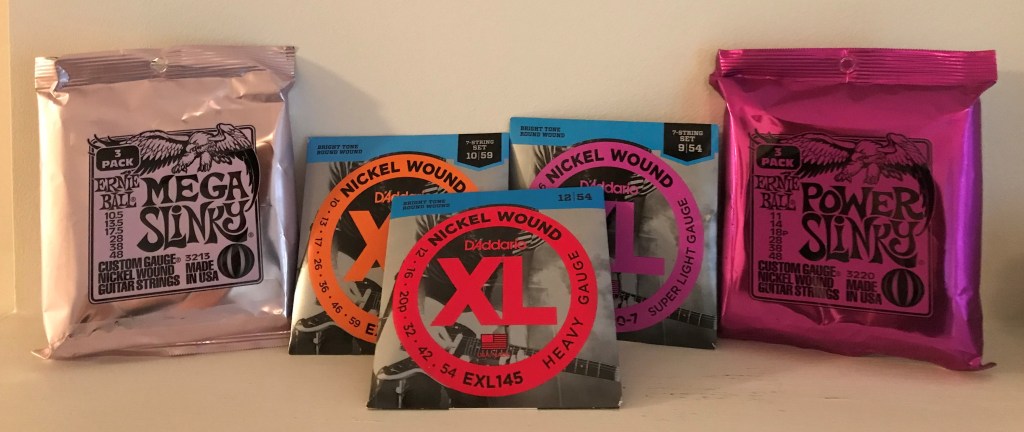
But I tend to come back to the D’Addario strings time after time. In addition to liking the feel of them, I like that you can buy D’Addario strings as a single set or in multi-packs. They come in 3-, 5-, and 10-packs. You can save money by buying more than one set at a time. Below I give you the links to each of the gauges that I use so that you can find them easily. (You don’t pay more by clicking these links, I’m giving them for your convenience).
| Number of Sets (Packs) | Gauge (lighter to heavier) |
| 1 | .009, .010, .011 |
| 3 | .009, .010, .011 |
| 5 | .010* |
| 10 | .009, .010, .011 |
After over 30 years of using D’Addario strings, I can say they’re a good value. They are consistently high quality and are easy to find for all instruments.
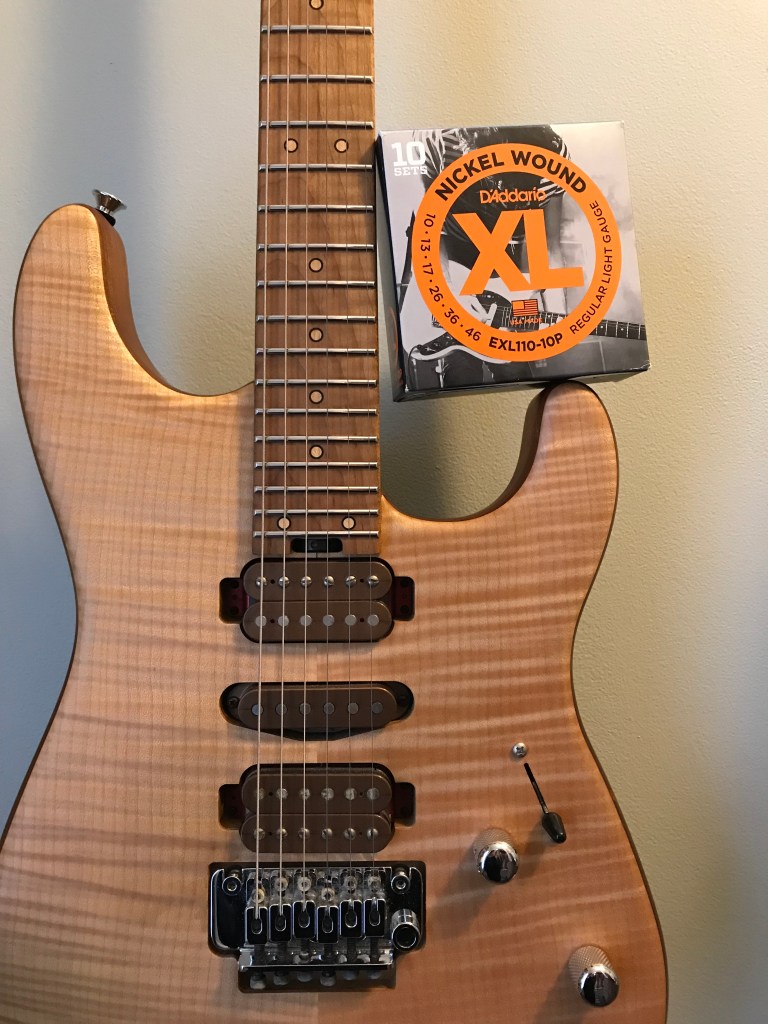
I provide links to several of the products mentioned above so you can use my affiliate links. You don’t pay more by using these. It just helps support me.
 learnyourguitar.com
Leave a comment